Last Updated on September 7, 2025 by Gill
Ever wonder if your PC is holding back that high-end graphics card, or if the processor is the real limiter?
Enter your CPU, GPU, and game settings and our tool instantly estimates whether your system will limit performance or let your rig shine. It evaluates Resolution, Refresh Rate, Graphics Settings, and Game Type so results match how you play.
Two headline outputs show the core story: CPU Bottleneck % and GPU Bottleneck %. Those numbers explain which component is the limiter and how that affects real-world Avg FPS and Max FPS projections.
We also offer a Hardware Matching Reference that classifies builds as Budget, Mid-Range, High-End, or Unbalanced. That makes it easy to check bottleneck and pick the next logical upgrade.
Key Takeaways
- Quickly check bottleneck using familiar inputs like screen resolution and refresh rate.
- See clear CPU vs GPU % results and what they mean for frame rates.
- Avg FPS and Max FPS translate technical data into playability expectations.
- Hardware Matching helps you judge if a graphics card pairs well with your CPU.
- Recommendations prioritize upgrades to match your video game goals and settings.
Start Here: Check Bottleneck Results for Your GeForce RTX 4090
Enter your CPU, GPU, and display settings to get clear, actionable performance numbers. The tool runs an instant analysis and shows CPU % and GPU % so you can check bottleneck result fast.
Instant analysis: CPU bottleneck %, GPU bottleneck %, Avg/Max FPS
Inputs: select CPU, select GPU, pick your screen resolution, refresh rate, graphics preset, and game type. Then hit Analyze.
Outputs: you’ll see CPU Bottleneck %, GPU Bottleneck %, Avg FPS, and Max FPS. This bottleneck result card turns technical data into numbers you can act on.
What you’ll see: Current configuration snapshot and optimization suggestions
“Your Current Configuration keeps all inputs visible so tweaking is fast and repeatable.”
- Quickly check bottleneck by changing resolution or settings and rerunning the test.
- See a Current Configuration summary with CPU, graphics card, and screen resolution at a glance.
- Receive Optimization Recommendations tailored to your result 1080 or result 1080 1440 scenarios.
This quick-start layout helps you move from data to action. Try different presets to observe how 1080, 1440, and other resolutions shift which component limits performance.
How Our rtx 4090 bottleneck calculator Works
We run your CPU and GPU through simulated playtests to reveal where performance tops out. A short intro shows what inputs matter and why they change real-world numbers.
Inputs we analyze
- CPU model and GPU model — the core hardware that sets processing and rendering limits.
- Screen resolution and refresh rate — higher values shift load toward the graphics card.
- Graphics settings and game type — these alter draw calls, physics, and CPU overhead.
Behind the scenes
Our algorithm compares expected frame pacing and utilization windows to compute CPU and GPU percentages. It matches your pairing to similar balanced builds and uses that matrix to infer a reliable bottleneck result.
The model reports Avg/Max FPS with each percentage so you can check bottleneck result and see playable impact. We aim for about 95% accuracy by testing many hardware combos and tuning the matching logic.
Hardware Matching Reference
- Budget, Mid-Range, High-End, and Unbalanced labels place your setup in context.
- If your build is Unbalanced, the report points to the component to upgrade for smoother play at 1440 geforce rtx settings or other presets.
Understanding Your Results: From “Result 1080” to “1080 1440” Scenarios
A concise results card converts your chosen resolution and presets into actionable percentages that reveal resource limits.
What a percentage means: a score under about 7–11% signals near-optimal synergy and minimal performance loss. Higher values show one component is notably limiting frames.
What a bottleneck percentage means
These percentages quantify how much one part caps performance. If your bottleneck result 1080 sits in the optimal band, you can expect smooth play without targeted upgrades.
CPU vs GPU constraint types and how they impact Avg/Max FPS
When the CPU is the limiter you often see limited gains from lowering graphics settings at the same resolution. The processor is busy scheduling frames.
When the graphics card is the limiter, lowering resolution or quality tends to raise frame rates more directly. Avg FPS shows sustained playability; Max FPS shows short peaks.
Example: AMD Ryzen 5 3600XT with GeForce RTX 4090
Our reference pairing reports about an 18.93% CPU-side constraint. That bottleneck result 1080 suggests a faster processor would unlock higher sustained FPS.
- Translate results across resolutions: a result 1080 system may shift toward 1080 1440 balance at higher pixel loads.
- Use the readout to plan upgrades—CPU tuning for draw-call heavy scenes, or GPU focus for shader-heavy video game moments.
“The tool is about 95% accurate in identifying which component limits performance, so use its signals to guide sensible improvements.”
Game Bottleneck Calculator Use Cases: General Tasks vs GPU-Intense Tasks
Not all games load your PC the same way; some push the processor while others max out the graphics pipeline.
General tasks like matchmaking, background apps, or streaming can steal CPU cycles and raise the CPU percentage during play. This means your system may show higher general tasks cpu impact even if the graphics card is powerful.
When the processor limits play
CPU-intense tasks include huge NPC counts, complex physics, and high tick-rate multiplayer. These tasks cpu intense moments often expose the processor as the limiter.
When the GPU limits play
Conversely, tasks gpu intense include ray tracing, ultra textures, heavy post-processing, and high anti-aliasing. Intense tasks gpu like these saturate the graphics pipeline first and reduce average frame rates at high resolution.
Why this matters: knowing whether your sessions are general tasks or cpu intense tasks helps you choose settings that match goals—responsiveness for competitive play or visual fidelity for cinematic experiences.
“Adjust shadows, crowd density, or ray tracing to shift load where it improves play most.”
| Use Case | Typical Limiter | Suggested Tweak |
|---|---|---|
| High NPC simulation | CPU | Lower crowd density or physics detail |
| Ray-traced single-player | GPU | Reduce ray tracing or shadow quality |
| Streaming + gaming | CPU | Offload encode to hardware or lower background apps |
| High-res cinematic play | GPU | Drop textures or post-processing |
Optimization Recommendations from the tool map your typical general tasks and gpu intense tasks to settings that save money and time. Tune the component actually limiting your performance instead of guessing at upgrades.
Resolution Matters: Screen Resolution and Graphics Settings at 1080 and 1440
Choosing 1080p or 1440p reshapes the performance picture and the trade-offs you’ll accept.
Result 1080 systems often expose CPU limits because the graphics card can push frames faster than the processor can feed them. That makes high refresh targets reveal how much headroom the CPU has.
Move to 1440 geforce rtx settings and the pixel load rises. The graphics card usually takes a larger share of work, which can smooth frame times if the CPU was the previous limiter.
“Result 1080” vs “1440 GeForce RTX” performance expectations
At 1080, prioritize freeing CPU cycles for high Hz play. At 1440, lean into GPU features and accept lower peak FPS if frame times stay steady.
Balancing Refresh Rate and Graphics Settings for smoother gameplay
High refresh rates change the balance: a 240 Hz aim stresses CPU scheduling more than locking 120 Hz at richer presets.
- Turn down heavy CPU tasks for competitive play at 1080.
- Reduce ray tracing or shadows at 1440 if FPS dips under your target.
- Use the tool’s hardware matching to see whether your build fits 1080 1440 goals.
“Set your visual target first, then tune around the limiting component shown in your result 1080 1440 readout.”
Optimization Recommendations: From CPU Upgrades to Overclocking
Small tuning moves can shift work between your processor and graphics card and unlock smoother play.
CPU upgrade path and safe overclocking
If the tool shows a high bottleneck result on the processor side, move to a CPU with better single-thread clocks and more cores. That change often yields the largest, most stable FPS gains.
Consider safe overclocking on a capable motherboard. Use moderate voltage, monitor temps, and stress-test after each step to protect longevity.
Tuning tips to shift load between CPU and GPU
Tweak view distance, crowd density, and simulation settings to reduce CPU work. Lower the heaviest graphics effects — ray-trace levels, ultra ambient occlusion, and top-tier anti-aliasing — when the graphics card limits play.
Re-run the bottleneck calculator after each change to check bottleneck result and confirm improvements.
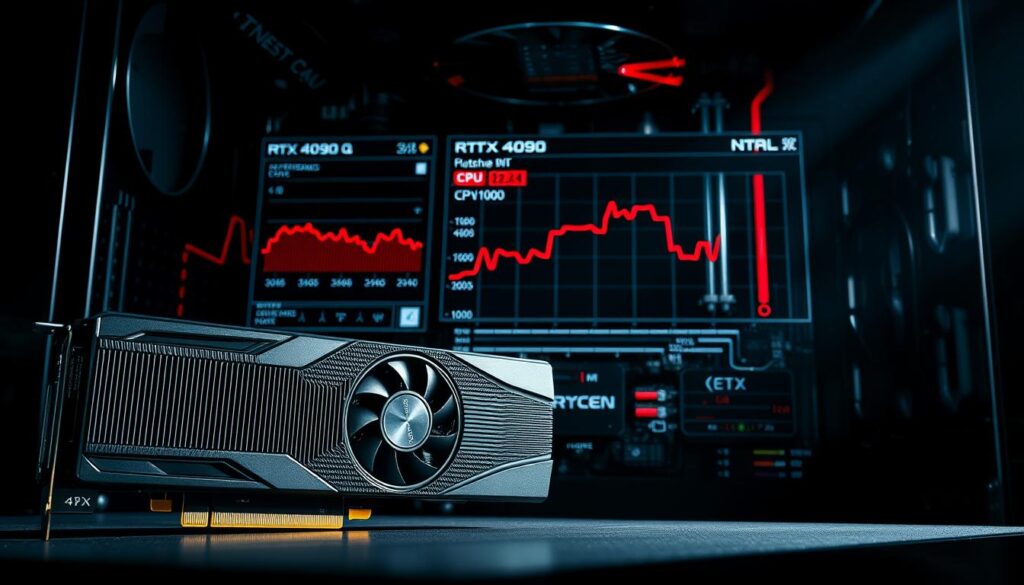
| Issue | Primary Fix | Quick Win |
|---|---|---|
| CPU-side limit | Upgrade CPU or safe overclock | Lower view distance / crowd |
| GPU-side limit | Reduce ray tracing and ultra textures | Drop AO or heavy AA |
| Thermals/Power | Improve cooling and PSU | Undervolt or lower clocks |
“Match upgrades to the report: fix the primary limiter first, then refine visuals to taste.”
Comparisons and Alternatives: GeForce RTX 3060, 4060, 5060, 5070, and Core Ultra
Compare midrange and high-end GPUs to decide which upgrade actually improves your gameplay. Use the tool to spot an Unbalanced build so you avoid overspending on a graphics card that won’t help.
When a top-tier card is overkill: if the report shows the processor as the limiter for 1080 or 1440 targets, a GeForce RTX 3060 or geforce rtx 4060 can hit high-refresh goals when paired with a strong CPU. For richer visuals at 1440 geforce rtx presets, consider stepping up to geforce rtx 5060 or geforce rtx 5070.
Planning upgrades: graphics card vs processor (Core Ultra) considerations
If your GPU is not the primary limiter, invest in a faster processor. A Core Ultra-class CPU often unlocks higher and steadier frame rates more effectively than moving from one high-end graphics card to another.
Check bottleneck result before you buy: participating retailers and qualifying purchases
Always re-run the analysis before checkout. Some pages include links participating retailers and purchases made links; purchases made through those links may earn commission. Check retailer disclosures on the retailers site so you know which qualifying purchases may earn commission qualifying purchases.
“Let the report guide upgrades: match CPU and graphics card to your display and games for real gains.”
Conclusion
strong, Make data your guide: one targeted adjustment often yields bigger gains than guessing at parts.
Run the bottleneck calculator, then check bottleneck result and act on the primary limiter. Re-run tests after driver updates, settings tweaks, or hardware changes to keep results current.
If your bottleneck result 1080 lands in the optimal band, focus on comfort and latency tweaks. If it points to the CPU, upgrade cores or clocks. If the graphics card limits you, refine visuals or consider a step up.
Test multiple presets—result 1080 and result 1080 1440—to see how 1080 and 1440 shifts workload. Use the Hardware Matching Reference to avoid bad buys and to decide between a geforce rtx 4060 or a different upgrade.
Thanks for using the tool—come back to check bottleneck as patches and drivers change.
FAQ
How does this tool determine if my GeForce card is limiting performance?
What inputs do I need to get an instant analysis?
What does a “result 1080” or “1080 1440” label mean?
How should I interpret a reported CPU constraint percentage?
Can the tool really be 95% accurate?
Do results show both average and maximum FPS?
My game is CPU-intense. How will that affect results?
What if my workload is GPU-intense like high ray tracing or ultra textures?
How do I balance refresh rate and quality settings for smoother play?
What upgrade paths reduce a CPU constraint most effectively?
When is a GeForce 3060, 4060, 5060, or 5070 a better choice than a flagship card?
Should I upgrade the graphics card or the processor first?
Is there guidance for paired builds like Ryzen 5 3600XT with a high-end GeForce card?
How do participating retailers and qualifying purchases relate to the tool?
Can I use this for non-gaming tasks like video editing or simulation?
Are there quick tuning tips to shift load between CPU and GPU?
How should I interpret example results like “AMD Ryzen 5 3600XT with GeForce shows ~18.93% CPU constraint”?
Will changing resolution from 1080 to 1440 help balance my system?
Is there any cost or data sharing required to use the analysis?

Follow Gill for the latest tips on CPU/GPU balance, PC upgrade guides, and hardware troubleshooting.Gill is the founder of PC Bottleneck Calculator, a free online tool designed to help users identify and fix performance issues in their PC builds. With years of hands-on experience in computer hardware and system optimization, Gill is passionate about making complex tech concepts simple and accessible for everyone—from beginners to gamers and PC builders. His mission is to help users get the most out of their systems through smart analysis and expert insights.
Follow Gill for the latest tips on CPU/GPU balance, PC upgrade guides, and hardware troubleshooting.
- NVIDIA RTX 6000 Ada Generation 48 GB Bottleneck Calculation - October 17, 2025
- Optimize Your GeForce RTX 5070 Performance with Our Bottleneck Tool - October 2, 2025
- GeForce RTX 5090 Bottleneck Calculator: Optimize Your Setup - October 1, 2025